Pay Stub for Rental: Using Pay Stubs for Rental Applications
Landlords require pay stubs to verify income equals or exceeds the required rent threshold before approving an apartment application. We Generate Pay Stub Now: Instant Verification Tool using six layout options, including the Classic Earnings Statement and Modern Teal designs, giving contractors, freelancers, and self-employed applicants a print-ready earnings statement showing gross pay, deductions, and net income for each pay period.
What Do Landlords Require Before You Apply?
Rental applications hinge on one core requirement: documented proof of income. Property owners request this documentation before approving a lease, using it to confirm that an applicant can realistically cover monthly rent.
Affordability is the central question behind every request. Most owners look for gross monthly earnings equal to roughly three times the rent amount, a benchmark widely promoted among tenant-screening services. Other landlords apply a slightly softer standard, accepting income between two and three times the rent depending on the property, market, and applicant history. Either way, a pay stub for rental applications serves as the fastest way to demonstrate that math clearly.
Beyond the income multiple, landlords typically request supporting details that confirm employment stability and identity. Common requirements include:
- Current employer name and pay frequency
- Gross and net earnings for recent pay periods
- Year-to-date totals for income tracking
- A government-issued ID matching the applicant’s name
How Much Income Do Landlords Want to See?
Landlords generally want gross monthly income at two to three times the rent, with three times serving as the most common threshold. This figure protects both parties: it lowers default risk for the owner and signals genuine affordability for the applicant.
What Counts as Acceptable Proof of Income?
Proof of income rental documentation typically includes recent pay stubs, though some landlords also accept employment letters or bank statements. We built our psp-e2 documentation framework around this exact need, guiding applicants through landlord income verification step by step so every figure lines up before submission.
How Do You Gather Your Proof of Income?
Gathering proof of income starts with identifying which documents your employment situation actually produces. Landlords request a pay stub for rental applications more than any other document. Treat it as the single most common proof-of-income record in the leasing process. We recommend following these steps in order.
- Confirm your employment type first. Traditional employees pull existing pay stubs; self-employed applicants need a different document set.
- Request stubs from your employer’s payroll system or portal if you are traditionally employed.
- Collect the last two to three pay periods. Landlords typically want a recent, consistent record, not a single isolated document.
- Verify every line item. Each stub should show gross earnings, tax withholdings, deductions, and net pay for the period covered.
- Assemble substitute documents if stubs are not available. Tax returns, bank statements, or 1099 forms cover the gap for independent contractors and freelancers.
Why do pay stubs carry more weight than other documents?
Pay stubs are widely regarded as the most trusted form of landlord income verification because they confirm both employment status and earnings detail in one place. A single stub shows what an applicant earns, what gets withheld, and what actually lands in the bank account.
What if I do not receive traditional pay stubs?
Self-employed renters without standard stubs can substitute proof of income rental documentation such as tax returns, bank statements, profit-and-loss statements, or 1099s. These records serve the same verification purpose landlords expect from a payroll stub, confirming income stability without a traditional employer behind it.
How Do You Create a Pay Stub Fast?
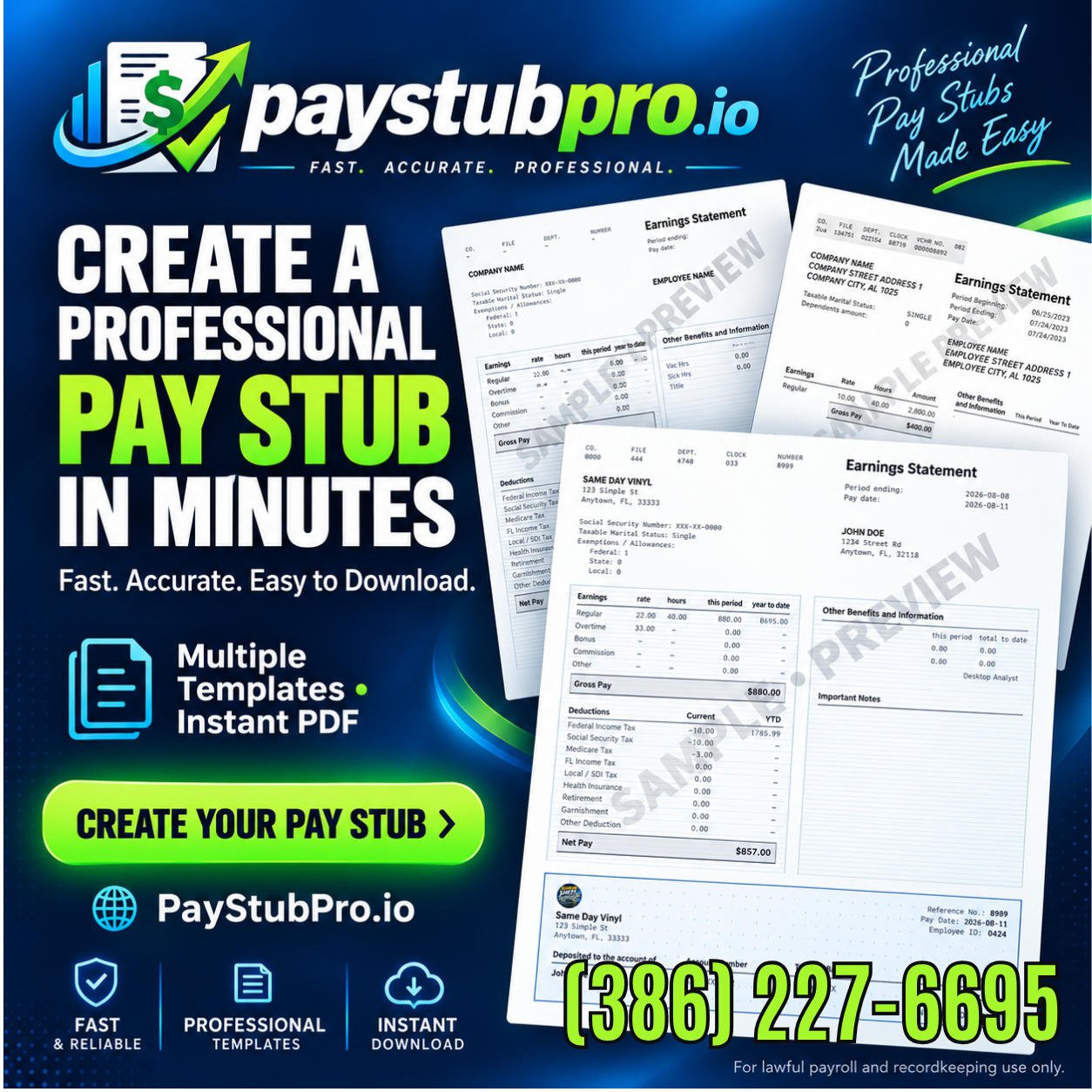
Speed comes from a guided sequence, not shortcuts. Three stages stand between a blank form and a finished document: entering payroll details, reviewing them, and generating a print-ready PDF. We built our platform around that exact sequence so applicants can move from empty fields to a submittable pay stub for rental applications in one sitting.
Follow these steps in order:
- Enter payroll information, including employer details, pay period, gross earnings, and deductions.
- Review every field for accuracy before moving forward.
- Generate the completed document as a print-ready PDF, ready for immediate submission to a landlord or property manager.
We designed this workflow to run on any screen. Our guided process is built for accuracy and functions across mobile phones, tablets. Desktops, so a document can be started on a phone during a lunch break and finished on a desktop that evening. No single device is required, and no software installation stands between an applicant and a completed statement.
Does It Matter If a Document Is Called a Pay Stub or a Check Stub?
No. The terms check stub, paycheck stub, and pay stub all describe the same earnings statement, regardless of which label a landlord uses. A property manager asking for proof of income rental paperwork accepts any of these terms interchangeably. Each refers to the identical breakdown of earnings, deductions, and net pay.
Is Pricing Clear Before Committing?
Yes. Transparent pricing, secure payment processing, and customer support remain constant throughout document generation, so costs stay visible before any purchase decision. This structure supports the broader goal behind landlord income verification: giving applicants a document that is accurate, accessible, and ready for review without hidden steps or surprise charges.
How Do You Pick the Right Template?
Template choice depends on the impression an applicant needs to make. The level of detail a landlord expects to see. We built several layout options precisely because rental situations differ: a corporate leasing office may expect a formal look. A smaller landlord may only need a clean, readable summary. Selecting the right pay stub for rental submission starts with matching format to audience.
Our Classic Earnings Statement uses a traditional navy header paired with a clear breakdown between earnings and deductions. This layout suits most industries. Pay frequencies, making it a dependable default when an applicant is unsure what a landlord prefers. For thorough landlord income verification, our Comprehensive Layout itemizes earnings, deductions, taxes, benefits, and year-to-date totals in expanded columns, giving property managers a complete financial picture in one document. Applicants who want a simple, no-clutter presentation can choose our Minimalist layout, which relies on generous white space and thin rules rather than dense sections.
Which template works best for proof of income rental submissions?
Most applicants do well with the Classic Earnings Statement, since its familiar structure reads clearly to landlords reviewing many applications. Applicants providing proof of income rental paperwork for stricter screening, however, benefit from the Comprehensive Layout’s added detail.
Consider these factors before selecting:
- Formality expected by the leasing office
- Amount of detail requested in the application
- Personal preference for visual simplicity versus full itemization
Each option remains fully editable and print-ready once generated.
What Mistakes Undermine Your Rental Application?
Inconsistent documents sink otherwise strong applications faster than low income ever does. A single pay stub for rental review tells a landlord whether an applicant pays on time, keeps paying, and truly is who the application claims. Gaps, mismatched names, or rounded numbers break that trust immediately.
We see three errors most often among applicants submitting proof of income rental paperwork.
Why do missing pay dates hurt an application?
Skipped or irregular pay dates worry landlords because steady cash flow is exactly what they’re screening for. A stalled year-to-date total raises the same concern. Non-payment ranks as the top fear among independent landlords, cited by 84 percent. Any sign of inconsistent income draws extra scrutiny during landlord income verification.
What other details commonly get flagged?
Beyond timing gaps, we find these mistakes repeatedly undermine applications:
- Incomplete deduction breakdowns — missing tax lines or benefit deductions look unfinished, not legitimate.
- Mismatched employer or personal information — names, addresses, or pay periods that contradict other submitted documents.
- Unrealistic or rounded figures — income that doesn’t reflect natural payroll math invites a second look.
We built our platform, sometimes referenced by internal designation psp-e2, around a guided process specifically to reduce these errors. Every field walks applicants through accurate entry before generating a print-ready document. Responsible, transparent use matters here: documentation submitted to a landlord must always reflect legitimate income. A polished, accurate pay stub gives applicants confidence that their paperwork will hold up under a landlord’s review, rather than raising the very questions it was meant to answer.
FAQ
How much income do landlords typically require?
Landlords generally want gross monthly income at two to three times the rent, with three times serving as the most common threshold used across tenant-screening services.
What documents should you gather for proof of income?
Collect the last two to three pay periods showing gross earnings, tax withholdings, deductions, and net pay. Self-employed applicants substitute tax returns, bank statements, or 1099 forms.
Why do landlords prefer pay stubs over other documents?
Pay stubs confirm both employment status and earnings detail in one place, making them the most trusted form of landlord income verification in the leasing process.
Conclusion
In closing, pay stubs serve as essential documentation for apartment rental applications, providing landlords with verifiable proof of your income and employment stability. Whether you are self-employed, a business owner, or a traditional employee, maintaining accurate and professional payroll records strengthens your rental application and demonstrates financial responsibility. By ensuring your pay stubs reflect legitimate earnings with precision and clarity, you position yourself favorably in the competitive rental market and establish the credibility necessary for successful lease approval.